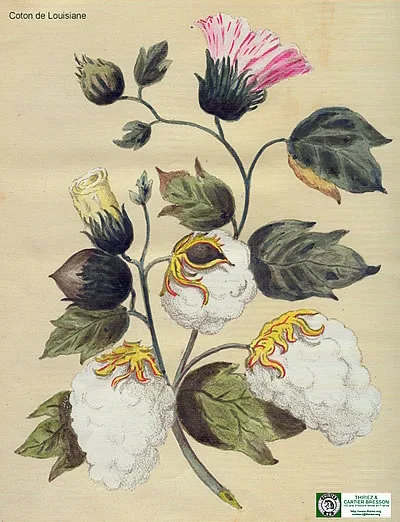
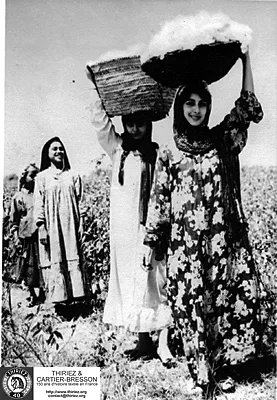
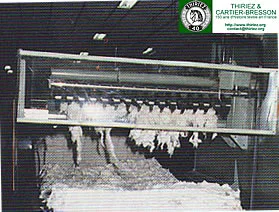
"La filature est l’art de produire, par des procédés mécaniques, des fils d’une longueur illimitée avec des éléments premiers limités".
"Dans l’épaisseur d’un fil de coton, on trouve 100 à 250 fibres, longues de 1 à 3 centimètres. Avec 20 grammes de fibres, on peut fabriquer un fil fin de un kilomètre de long".
"Ce n’est qu’à la fin du XVIIème
siècle que le travail du coton devint réellement une
industrie et une source de richesse publique, aussi bien en France
qu’en Angleterre.
Ce fut d’abord la fabrication avec la roue à un fil,
notamment à Rouen vers 1725, avant l’invention de la
machine à carder en 1748 par Daniel Bourne, de Leominster,
et Lewis Paul . En 1760 James HARGREAVES invente le rouet à
six broches, la "Jenny", du nom de sa fille, et ensuite
la "Mull-Jenny", avec un métier à filer. La première cardeuse totalement automatisée fut inventée
par Richard Arkwright vers 1772.
Les prémices de notre industrie cotonnière, à Lille, Rouen, Amiens et Mulhouse sont de 1795 à 1800.
Il est de la plus grande importance de bien savoir choisir le coton en vue de telle ou telle fabrication à obtenir .. la réussite des filatures dépend beaucoup de cette connaissance".
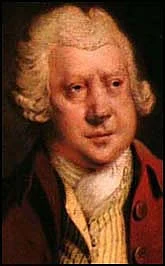
Richard Arkwright
Process :
- Égrenage : séparation des fibres de la graine par des égreneuses : à scies (les plus courantes), à rouleaux (pour longues ou très longues soies), nettoyage, pressage en balles de 80 à 230 kg [par convention, 1 balle = 480 livres (217,7 kg)]. Le classement des balles de coton se fait progressivement d'une manière automatique. Il reste sur la graine le fuzz (ou linter) de faible valeur qui pourra être enlevé mécaniquement ou chimiquement par la suite, par l'opération de délintage.
- Filature : consiste à ouvrir la fibre venant des balles, la nettoyer, la mélanger, la carder, étirer le ruban à carde et le doubler, puis le mettre sous forme de mèche avant la filature proprement dite. Pour du coton à fibre longue, une étape de peignage permet d'enlever les fibres courtes pour réaliser des fils fins. La filature peut être à anneaux (ring spinning) ou à rotors (open-end) plus rapide mais conçue pour des fibres plus courtes. Filés retors : filés de plusieurs fils réunis par torsion. Fil d'Écosse : fil pur à longues fibres retors, gazé et mercerisé. Le coton filé est caractérisé par un numéro anglais Ne (nombre d'écheveaux de 840 yards dans 1 livre de fil) ou un numéro métrique Nm (nombre de km de fil dans 1 kg de fil) ou par le poids en g d'un km de fil (système Tex). (source : QUID)
"Two types of carding machines
had been developed in the 18th Century. The first, which was originally
invented by Daniel Bourne in 1748 and resembles the modern roller
card, had four revolving cylinders in contact, each faced with carding
wire. The second machine -invented by Lewis Paul -comprised a cylinder
with 20 lengthwise strips of card wire, to engage fixed cards in
a concave hood. This is in fact the basis of today's modern flat
carder used for cotton. On this machine, which was initially hand
driven, the fibre was stripped from the roller with a needle-stick
carrying close rows of projecting teeth.
Paul's carding machine was improved firstly by John Lees in 1772,
who added a 'perpetual revolving cloth' on which the scoured wool
was spread and then fed to the roller, and, secondly by Richard
Arkwright, who in 1775 added the crank and comb. A subsequent modification
(1785) -again by Arkwright -ensured a continuous carding by means
of a comb joined to the cylinder and worked by a crank.
Whereas carding had been mechanised to some degree, combing was
still completely hand-oriented, and, despite the efforts of Edmund
Cartwright who in 1794 introduced the first combing machine, it
was several decades into the 19th Century before combing machines
achieved the required degree of perfection for widespread use. Three
'tools' were used in hand combing: a pair of combs, a post to which
one of the combs was fixed, and a comb-pot or small stove for heating
the teeth of the combs. The comb was a T-shaped piece of wood, with
rows of long-pointed steel teeth along the head".
cf. www.austehc.unimelb.edu.au
By 1741 this machine, powered by donkeys, was being used in a mill in Birmingham. Soon afterwards Wyatt and Paul went bankrupt. However, five of their machines were purchased by a man called Cave who installed them in his new factory in Northampton. This was the first cotton-spinning mill in history, but the Roller Spinning machine proved to be unreliable, and no one else followed Cave's example.
In 1748 Lewis Paul invented a hand driven carding machine. The devise involved a card covered with slips of wire placed round a cylinder. The idea was later developed by other inventors such as Richard Arkwright and Samuel Crompton.
Paul and Wyatt continued to try and improve their Roller Spinning machine and a second patent was taken out in 1758. Richard Arkwright later used the machine as a model for his water frame. Lewis Paul died in 1759
Arkwright's Spinning-Frame was too large to be operated by hand and so the men had to find another method of working the machine. After experimenting with horses, it was decided to employ the power of the water-wheel. In 1771 the three men set up a large factory next to the River Derwent in Cromford, Derbyshire. Arkwright's machine now became known as the Water-Frame. He was knighted as Sir Richard Arkwright in 1786, and he died one of the richest men in England."
www.spartacus.schoolnet.co.uk
Sources :
- "La Filature du coton, numéros moyens et gros, suivie du travail des déchets et cotons gras", par E. SALADIN, Éditions Léon Deshays Rouen 1885
- sites : www.cvmt.com, www.austehc.unimelb.edu.au, www.spartacus.schoolnet.co.uk, www.cirad.fr, www.quid.fr, www.snv.jussieu.fr
 Ouvraison
et battage